Overarching Theme
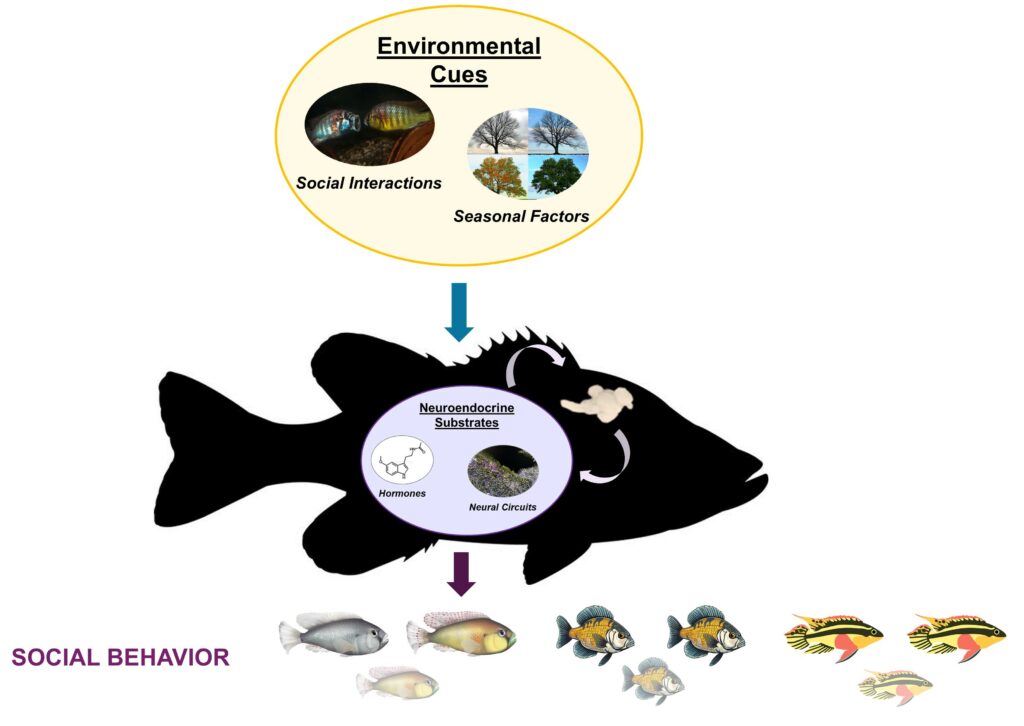
Many species live in groups, in which stability is maintained via hierarchies. Social hierarchies generally consist of higher-ranking dominant (DOM) individuals, which have greater access to resources and higher reproductive success than lower-ranking subordinate (SUB) individuals. Social rank has profound effects on physiology and behavior, including changes in hormone production, neural circuitry, and neuromodulatory signaling, and these processes are strikingly different between DOM and SUB individuals in a social group. Interestingly, these hierarchical structures are dynamic and can be altered due to naturally occurring changes in the environment, including both social and physical factors. Our lab’s central goal is to identify the neural and molecular mechanisms underlying this remarkable social plasticity in African and Neotropical cichlid fishes. Specifically, we manipulate the social environment and seasonal abiotic factors to uncover the mechanisms underlying naturally occurring neural and behavioral plasticity across species.
Our Study Species
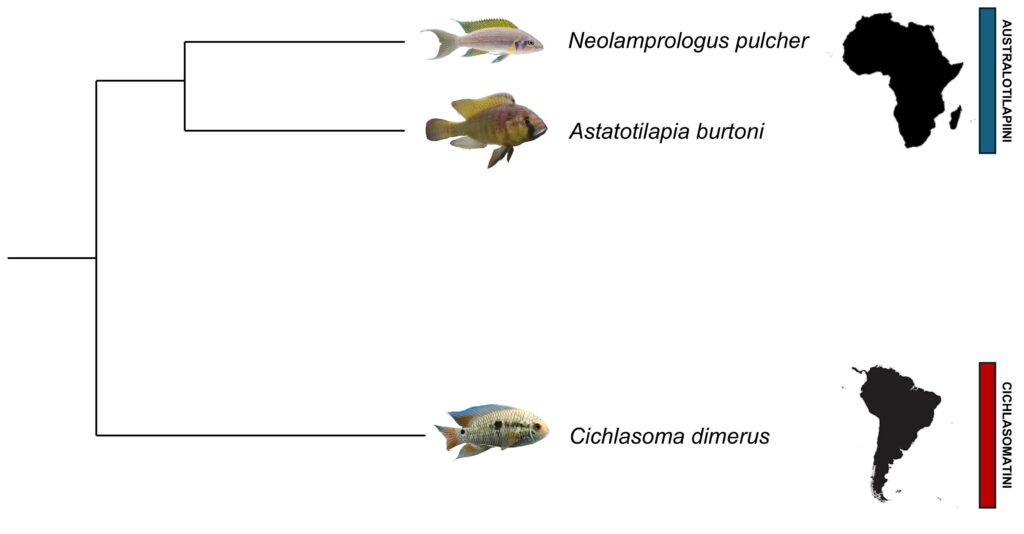
Cichlids (family Cichlidae) are a geographically widespread group of teleost fishes consisting of over 1,700 species divided across African, Neotropical, and Malagasy/Indian clades. These fishes show exceptional diversity in their life-history strategies, social structures, and reproductive systems. For example, the African cichlid Astatotilapia burtoni exhibits male-only hierarchies and lives in social groups consisting of multiple breeding pairs. Conversely, the cooperatively breeding African cichlid Neolamprologus pulcher exhibits all-individual hierarchies, in which SUB males and females stratify along the same hierarchical structure, and lives in social groups consisting of SUB helpers and one dominant breeding pair. Although A. burtoni and N. pulcher reproduce year-round, some species breed seasonally, including the South American cichlid Cichlasoma dimerus. C. dimerus exhibits same-sex hierarchies, in which males and females form separate social hierarchies, and lives in social groups consisting of one dominant breeding pair. By studying these species in tandem, our research provides a powerful framework for examining the regulation and evolution of social plasticity in group-living animals.
Current Projects
- Neural control of social subordination by serotonin and neuropeptides in A. burtoni
- Seasonal and hormonal regulation of social rank and group dynamics in C. dimerus
- Sex and species diversity in the neuroendocrine mechanisms of social behavior (A. burtoni, C. dimerus, and N. pulcher)
Funding
- Natural Sciences and Engineering Research Council of Canada (NSERC) Discovery Grant (2026-2031)
- Natural Sciences and Engineering Research Council of Canada (NSERC) Discovery Launch Supplement (2026-2031)
- Faculty of Science Start-Up Funding, University of Alberta (2025-2027)